2025-26 Key Achievements

Catalyzing Alberta's Learning Health System

AbSPORU’s four teams (Data and Research Services, Patient Engagement, Capacity Development, Learning Health System) contribute directly to health system improvement and evidence-informed policymaking. Outlined below are the achievements of our teams that cumulate to AbSPORU's shared success.

Impact at a Glance

Across research, health systems, patient engagement, and capacity development, AbSPORU services contributed to a breadth of innovation and impact in 2025-26. A summary of instances of achievement include:

  • Progressed the Snowflake Trusted Research Environment and expanded Connect Care-enabled research, upholding Alberta’s health data infrastructure and contributing to Canada’s emerging national health data platform.
  • Generated more than $60 million for AbSPORU-related clients by supporting successful grant applications.
  • Supported the Every Drop Counts initiative, advancing evidence-informed transfusion practice and avoiding more than 3,280 unnecessary blood transfusions while generating nearly $2 million in cost savings and reducing the environmental footprint of healthcare. 
  • Accelerated learning health systems through embedded implementation science support for major provincial initiatives like the Acute Care Bundle Improvement (ACBI) innovation and the national PRIME (Primary Care Reimagined through Impact, Mobilization & Engagement Rapid Response) grant application.
  • Advanced an equitable, just, and Indigenous-centered health system through meaningful partnerships like the Sowing the Seeds of Equity implementation science collaborative workshop and an ongoing primary care collaboration with the Metis Settlements. 
  • Renewed leadership of the PaCER curriculum through our partnership with the University of Calgary. 
  • Supported the Buffalo Seekers (“Iini’a’pssapi”) PaCER cohort with Indigenous-led POR and autism-inclusive engagement initiatives. 
  • Expanded capacity for patient-oriented research across the province through certificate programs, health data workshops, graduate studentships, and e-learning opportunities that reached 187 unique learners. 
  • Celebrated our 10th Anniversary Northwest SPOR Collaborative Forum, hosting 372 members of the patient-oriented research community from across Canada and internationally.

Some Examples

Incremental Dialysis Program
Saved ~400 dialysis runs every month, leading to performance improvements, system efficiencies, and cost optimization.

Dialyzing Wisely
(funded through PRIHS)
Improved dialysis adherence by 11% in Alberta ICUs, with projected cost savings of $12 million over the initial 3-year project.

Don’t Misuse My Blood1
Unnecessary blood transfusions in ICU units were reduced by 29%, saving ~$40,000 monthly, along with potential patient harms.

COVID Rapid Response & Long-COVID Studies
Real-time data-driven support for the province’s pandemic response and long-term system planning.

Our Way to Wellness
A Metis-led primary care initiative with embedded knowledge mobilization and implementation science support.

We couldn't do any of this without you… Your whole team are the most important research collaborators we have—and will likely ever have.
Dr. Scott Garrison, Principal Investigator, BedMed, BedMed-Frail and MinMed Trials

DATA AND RESEARCH SERVICES

AbSPORU’s Data and Research (DRS) Team provides access to health data, advanced analytical expertise, and modern data infrastructure to Alberta’s research community.

In 2025-26, demand for services was strong, receiving 298 new requests for data access. They expanded access to increasingly complex data sets and now support 70 administrative health datasets, including two new standardized data resources introduced this year. 

The DRS team has successfully expanded its analytical capacity to meet growing demand, with 43.6 Full-Time Employees supported through AbSPORU funding including in-kind contributions and service-generated cost-recovery revenue. Along with demand, complexity of requests has also increased. 

In 2025-26, 21% of completed data requests incorporated Connect Care data, which requires substantially more elaborate data mapping, extraction and validation.

The DRS team continues to navigate significant changes across Alberta’s health system and respond to the evolution of Alberta’s health data environment. In response, they have expanded their project triage capacity and implemented ServiceNow to capture requests, streamline service intake and improve project management.

Research in Action

The impact of AbSPORU’s DRS team is felt across Alberta’s health system, spanning initiatives that support critical care, chronic disease management, rehabilitation, cardiovascular care, population health, and Indigenous-led research.

Don’t Misuse My Blood
This initiative developed real-time data infrastructure to evaluate the impact of reducing unnecessary blood transfusions across Alberta. By February 2026, the initiative had contributed to:

  • approximately $1.95 million in cumulative cost savings
  • 3,282 blood transfusions avoided
  • 24.3% improvement in transfusion appropriateness
  • and implementation across 39 critical care and high-risk surgical units, leading to expansion into hospital-wide implementation at ten acute care sites.

One: CarePath:
One: CarePath is a community-based program helping Albertans living with advanced chronic illness remain well in their communities. With the Team’s support, the project enrolled more than 2,600 patients and 100 physicians, generating the evidence needed to evaluate long-term clinical and economic impact.

CONCENTRIC:
In collaboration with Dr. Chester Ho (Universities of Alberta and Calgary) and colleagues, the DRS Team, supported the CONCENTRIC spinal cord injury initiative through development of province-wide analytical dashboards and validation of new administrative case definitions, addressing longstanding gaps in surveillance, healthcare planning, and resource allocation for individuals living with traumatic and non-traumatic spinal cord injury.

Strengthening Indigenous Data Capacity

During the reporting period, DRS team members completed formal OCAP® (Ownership, Control, Access, and Possession) training and participated in the Alberta First Nations Information Governance Centre Data Custodians Meeting, strengthening their capacity to support Indigenous data governance.

These activities help to build capacity to support First Nations and Metis communities through respectful, culturally appropriate approaches to health data stewardship and Indigenous-led research.

Collaboration on Health Data

AbSPORU continued to strengthen our collaboration with HDRN Canada to advance interoperable health data infrastructure for multi-jurisdictional research. This ensures that our impact reaches beyond Alberta and enables federal knowledge users access to Alberta’s expertise. Supporting projects include:

  • Implementation of the OMOP Common Data Model to enable cross-jurisdictional data harmonization
  • Advancement of the MASK project to improve de-identification of free-text clinical notes
  • Development of privacy-preserving approaches for combining small cell counts across jurisdictions, an important advancement for rare disease research.


The DRS Team and HDRN Canada also continued working together to develop an enhanced national service model to streamline access to multi-jurisdictional data.

Building Alberta's Next Generation of Research Infrastructure

The infrastructure that supports Alberta’s health data capabilities is crucial to improving the efficiency, quality, and accessibility of research data. AbSPORU’s DRS team achieved several infrastructure-related milestones during the 2025-26 year:

Snowflake Trusted Research Environment (TRE)

The DRS team led progress toward implementation of Alberta’s Snowflake Trusted Research Environment (TRE) by advancing internal testing and legal and governance work. The TRE will provide researchers with secure access to approved datasets within a protected analytical environment, significantly expanding capacity to support complex health data research.

Standardizing Provincial Data Assets

The DRS team developed two province-wide standardized data resources:

  • Laboratory Data Mart: integrates Connect Care and historical laboratory data into a single standardized resource and harmonizes definitions across multiple source systems.
  • Consolidated Mortality Table: integrates mortality information from Vital Statistics, the Provincial Register, and Connect Care, to provide a single standardized source for mortality data across research projects.


The creation of these two resources brings AbSPORU’s data holdings up to 70, an increase of 54 since 2014.

LEARNING HEALTH SYSTEM

AbSPORU's Learning Health System (LHS) Team provides embedded implementation science, knowledge mobilization, and evaluation expertise to help partners co-design, implement, evaluate, and sustain evidence-informed improvements in healthcare delivery, policy, and practice.

Advancing Implementation Science

Acute Care Bundle Improvement
In 2025-2026, we provided continued support for the Acute Care Bundle Improvement (ACBI) innovation, a province-wide Alberta Health Services program designed to align multiple improvement initiatives into a coordinated, evidence-informed approach.

Implemented across 14 adult acute care sites, ACBI contributed to improvements in clinical workflow, discharge planning, and standardization of care while reducing length of stay and postoperative infections. Patient research partners participated in co-developing site-specific action plans, refining implementation resources, and evaluating implementation strategies.

The co-development of the ACBI Implementation Framework and Implementation Playbook were significant accomplishments in the period and aim to provide practical guidance to support local implementation.

Sowing Seeds of Equity
Sowing Seeds of Equity was a three-day workshop that brought together researchers, practitioners, patient partners, community members, and advocates to explore equity- and justice-centered approaches to implementation science and learning health systems.

Co-hosted by LHS Team Co-Lead, Dr. Stephanie Montesanti (University of Alberta) and Dr. Cory D. Bradley (Northwestern University), the workshop led to the co-creation of a Manifesto that articulated a shared vision for equity-centered implementation science and generated new and ongoing collaborations, scholarly outputs, and an emerging community of practice.

The LHS:STAT Podcast featured two original series in 2025-26:

  • JustIS in Learning Health Systems, exploring equity- and justice-centred implementation science and learning health systems through conversations with international leaders
  • AB-POR You (Arts-Based Patient-Oriented Research for You), highlighting innovative arts-based approaches to patient-oriented research, patient engagement, and knowledge mobilization through discussions with researchers, artists, and patient partners.

Research in Action

Implementation science and evaluation expertise provided by the LHS Team to initiatives that evaluate changes in clinical practice and healthcare delivery are contributing to changes in practice and in policy. 

Kidney Check – continued evaluating a community-based health screening program developed in partnership with First Nations communities. AbSPORU supported the initiative, led by the SPOR-funded Can-SOLVE CKD Network, with qualitative analysis, consensus-building, and interpretation of implementation findings. Since 2023, more than 270 people have been screened across five Alberta communities.

The Perioperative Glycemic Management Pathway (PGMP) continued implementation across six Alberta hospitals. LHS Team members served on the project's Steering Committee and Implementation Advisory Committee, providing implementation science expertise throughout implementation and evaluation. Early findings indicate reductions in hospital length of stay and postoperative infections.

A Provincial Telemonitoring initaitive was supported by ABSPORU’s LHS Team with implementation planning and contributions to the ethics application and implementation evaluation framework for a three-year study of remote inpatient monitoring technologies. The initiative was originally led by the Medicine Strategic Clinical Network (MSCN) and its Respiratory Health section. 

Knowledge Mobilization Portfolio

Key knowledge mobilization outputs included:

  • Alberta Implementation Guidebook
  • Climate-Resilient Acute Care Clinical Operations (CRACCO) Framework Version 2.0
  • HiMARC Resilience Hub digital platform to support the wellbeing of military members, Veterans, and public safety personnel
  • and more than 20 graphic recordings, visual summaries, and other knowledge translation products to support provincial, national, and international meetings and events.


At the Palix Foundation Fall 2025 Symposium, AbSPORU provided scientific writing support and synthesized discussions among 155 experts, decision-makers, and community leaders into a comprehensive report.

Indigenous Partnerships 

We continued to focus on strengthening partnerships with Indigenous communities and organizations to advance Indigenous-led implementation science, learning health systems, and community-driven health improvement.

Along with AbSPORU’s Data and Research Services team, we supported the Nipisihkopahk Medical Clinic (Samson Cree Nation) to develop a community-informed health data dashboard.

We continue to provide ongoing implementation support for the Metis Settlements' Our Way to Wellness initiative, a community-led effort to improve healthcare services across the eight Metis Settlements in Alberta.

Learning Health System team Co-Lead, Dr. Stephanie Montesant, hosted the Indigenous Primary Health Care and Policy Research (IPHCPR) Network's Annual Scientific Meeting in Edmonton in June 2026. Centered on the theme Indigenous Health Workforce, the meeting was a collaboration focused on advancing Indigenous primary health care through research, relationships, knowledge mobilization, and system transformation.

Implementation Science Training

The Learning Health System team is proactive in creating opportunities to develop capacity for patient-oriented implementation science and knowledge mobilization through curated learning opportunities.

Seventeen participants completed AbSPORU’s Implementation Science Certificate Program during Fall 2025. The updated curriculum incorporated equity throughout while continuing to build practical implementation science skills. Participant feedback highlighted the value of peer discussion, structured implementation planning tools, and immediately applicable resources.

Implementation science workshops were developed and delivered, tailored to the needs of its recipients. These ranged from 30-minute presentations to three-hour interactive sessions.

The LHS team also continued its monthly Implementation Science and Learning Health Systems Discussion Series (September–June), featuring guest speakers from around the world presenting on emerging research and connecting Alberta participants through an informal forum for dialogue, collaboration, and ongoing professional learning. 

PATIENT ENGAGEMENT

AbSPORU's Patient Engagement (PE) Team strengthens patient-oriented research (POR) across Alberta through the facilitation of collaboration among patients, communities, researchers, and health system partners. The team helps to ensure that lived experience informs research priorities, study design, and knowledge mobilization which impacts the health system in a positive way. Patients are at the heart of everything we do, and our Patient Engagement Team is constantly striving to put the patient voice at the forefront of health innovation.

A Patient-Centred Approach

A strong network of invested patient and community partners is important to facilitating a patient-oriented approach to research.

Albertans4HealthResearch (AB4HR)
AB4HR is an active, provincial patient engagement community that connects researchers with patients, caregiver, family members, and community members who are interested in partnering in health research. Through the AB4HR network, AbSPORU helps match researchers with patient partners, and promotes opportunities to get involved in the health research that affects them. Not as participants, but as active partners.

Alberta Youth Health Council
Alberta’s youth are passionate about improving the future of healthcare in the province. AbSPORU’s Alberta Youth Health Council creates opportunities for researchers to present projects directly to engaged youth and receive timely feedback.

The PaCER Program

During the reporting period, AbSPORU became recognized formally as the primary steward of the Patient and Community Engagement Research (PaCER) program under the scientific direction of AbSPORU’s Patient Engagement Lead, Dr. Maria Santana, and in partnership with the University of Calgary Continuing Education. 

The 160-hour professional certificate program trains patient and community partners in qualitative research methods, strengthening their ability to contribute as active and informed partners in patient-oriented research.

The team is also exploring opportunities to adapt elements of the curriculum into shorter micro-credential offerings to broaden access and tailor learning pathways for future participants.

Published in Health Expectations, a major qualitative evaluation of PaCER alumni and sponsors showed significant benefits for participants and research teams, including enhancement of:

  • patient engagement capacity
  • research skills
  • career development
  • and research competitiveness

A complementary bibliometric analysis found that PaCER graduates had co-authored a combined total of 331 peer-reviewed publications, which have been collectively cited more than 8,000 times.

This published research spans topics in healthcare navigation for newcomers, vaccine confidence, chronic autoimmune disease, and Long COVID, demonstrating the program’s sustained contribution to advancing the science and practice of patient engagement and POR.

Patient Engagement Training

Building capacity for patient engagement remains a key strategic objective of the Patient Engagement Team. They do this through curated training opportunities like:

Patient Engagement in Patient-Oriented Research Certificate Course
The popular PE in POR Certificate Course has been redeveloped in collaboration with AbSPORU’s Capacity DEvelopment Team and is scheduled to relaunch in Winter 2027 as a six-week program. The course is co-facilitated with patient partners to provide practical tools to participants so that they can build knowledge and skills for engaging patients and communities as partners in research.

MDCH 700: Public and Patient Engagement in Health Research
MDCH 700 is a three-credit graduate course, delivered through the University of Calgary, that provides students with a theoretical foundation in patient and community engaged health research. It also provides practical considerations for engaging patients and communities in research projects, with opportunities to learn directly from patient research partners, academic and clinical researchers, and other experts in the field.

Additional outreach and educational opportunities were undertaken by the team, developed and tailored to the needs of its recipients. This included participating in the University of Alberta’s Bench to Bedside initiative which introduced future clinician-innovators to the principles and value of patient engagement in health research. 

Knowledge Mobilization Portfolio

The Patient Engagement Team mobilizes a variety of tools that connect researchers, patients, and those in the health research ecosystem who are interested in keeping up to date with all things POR.

Patient Engagement Journal Club

Journal Club is a once-monthly webinar series that covers publications and news on the topic of Patient-Oriented Research. It is open to anyone interested in the science and practice of POR and recordings of the events now have over 750 views on YouTube.

AbSPORU Patient Engagement Learning Series (APELS)

APELS is a monthly 1-hour online session designed to support and empower researchers through partnered research projects with tools to strengthen their approach. Recordings of APELS sessions have surpassed 18,000 views.

Health Research Together Podcast

Formerly PEP Talks, the Patient Engagement Podcast has rebranded to Health Research Together, broadening the podcast’s focus to feature conversations between researchers, patient partners, and community members that explore the principles, practice, and impact of patient engagement and POR. The podcast serves as an accessible knowledge mobilization resource, sharing diverse perspectives and real-world experiences to support meaningful patient engagement in health research.

Research in Action

AbSPORU provides patient engagement-focused consultation and support to researchers developing and implementing patient engagement plans. Initial consultation often evolve into long-term research collaborations, with researchers recognizing the value of a POR-approach to their projects.

Partnerships and Health System Impact

Provincial, national, and community-focused partnerships were a focus of AbSPORU’s Patient Engagement Team in 2025-26. Work with collaborating organizations like the SPOR Chronic Pain Network, Diabetes Action Canada, and CanSOLVE-CKD Network was ongoing and strengthened the patient-oriented research community across the province and beyond provincial lines as the team co-develed a future national conference with the University of Calgary’s Vice-President Research Office for Community-Based Research Canada.

A milestone from these partnerships was co-leading the Painful Truths: Common Threads in a Tapestry of Chronic Pain and Identity digital storytelling initiative in partnership with the SPOR Chronic Pain Network, demonstrating innovative approaches to patient-led research and knowledge mobilization.

Alberta’s Diabetes Action Plan benefited from the patient engagement expertise provided by AbSPORU, working alongside policymakers, health system partners, clinicians, and patient partners to ensure that lived experience informed recommendations for improving diabetes care across the province.

Equity, Diversity, Inclusion, Accessibility, and Reconciliation

In 2025-26, we continued to foster inclusive, community-led approaches to patient engagement and POR as part of organizational commitment to Equity, Diversity, Inclusion, Accessibility, and Anti-Racism (EDIAA).

Key EDIAA and Reconciliation Patient Engagement Projects

Working alongside individueals with lived experience of autism, the PE Team co-designed an accessible learning session focused on authentic representation and inclusion of autistic individuals in health research. The session adapted both the physical environment and session format to better meet participants needs.

Building on the success of this collaboration, the team delivered a dedicated session at AbSPORU’s Northwest SPOR Collaborative Forum in May 2026, creating a more inclusive environment while raising awareness of autism inclusion in health research.

The team's primary Indigenous-focused initiative during 2025–2026 was the Buffalo Seekers "Iini'a'pssapi" PaCER cohort, supported in partnership with Primary Care Alberta's Indigenous Wellness Core as the sponsor and led by Indigenous student researchers from the University of Lethbridge with guidance from Indigenous Elders.

Through interviews and focus groups conducted in both English and Niitsipowahsinni (Blackfoot), the research project explored how traditional cultural practices support Indigenous youth in "living in a good way," with findings informing the Indigenous Wellness Core's ongoing work.

CAPACITY DEVELOPMENT

AbSPORU's Capacity Development (CD) Team provides training and professional development opportunities to increase capacity for patient-oriented research in Alberta. AbSPORU prepares researchers, trainees, patient partners, health system professionals and other evidence users to generate, apply, and mobilize research evidence that helps improve health and healthcare.

Northwest SPOR Collaborative Forum: A Decade of Collaboration

For ten years AbSPORU has been hosting our popular Northwest SPOR Collaborative Forum—our flagship knowledge exchange event.
Since 2015, we have been bringing together researchers, patient partners, health system leaders and providers, policymakers and community organizations to share and celebrate successes and lessons in patient-oriented research. The result is new collaborations, new knowledge, and renewed motivations for Alberta’s patient-oriented research community.

In 2025 we hosted our 10th Annual Collaborative Forum: AbSPOR & YOU: Partnership. Innovation. Impact. We welcomed 372 participants from across Alberta, Canada and internationally, an increase of 180 participants over the previous year with growth in every audience category.

Day Two Keynote: Tim Caulfield

Timothy Caulfield of the University of Alberta delivered as our keynote speaker. His address, Tackling Information Chaos: Why Trust, Science, and Patients Matter, explored the prevalence of health misinformation and how the collective of our audience can work together to build trust through scientific evidence and consensus built on meaningful partnerships and engagement of patient, family and community members.

Graduate Studentship Program

AbSPORU's Graduate Studentship in Patient-Oriented Research program trains the next generation of patient-oriented researchers. Over 12 months, recipients receive a combination of $30,000 in funding and tailored training and mentorship.

Students receive individualized consultations with AbSPORU experts and gain connections to Alberta’s broader POR community. The impact of the program extends well beyond the individual award recipients as they bring their new knowledge and experiences back to their supervisors’ research programs and fellow trainees.

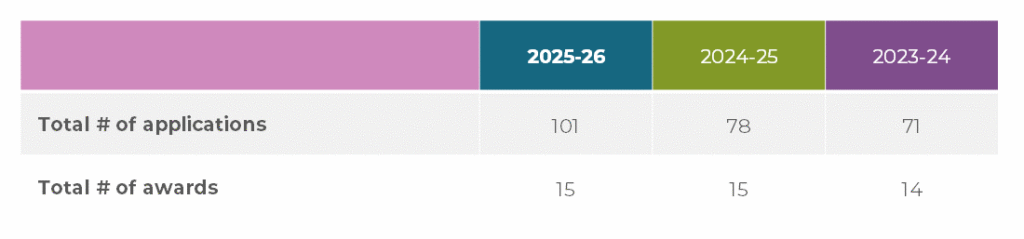
In 2025-26 AbSPORU invested $435,000 in 15 new recipients. Since 2015, AbSPORU has invested nearly $3.9 million in 133 graduate studentships. The program continues to grow. In 2025 we received 93 eligible applications, tripling the amount received in the first year of the program in 2015.

The return on investment is strong, with alumni of the program securing more than $7 million in subsequent research funding from organizations including CIHR, Alberta Innovates, Brain Canada, Mitacs, the National Institutes of Health (NIH), the Women and Children's Health Research Institute (WCHRI), and the Alberta Children's Hospital Research Institute (ACHRI).

AbSPORU Graduate Studentship Program

Phase II Overview

Educational Programs

AbSPORU’s Implementation Science Certificate was co-delivered by the Capacity Development Team and the Learning Health System Team. 

Now in its 4th iteration, the course saw 17 participants receive a microcredential badge. 121 participants in total have taken part in the course since it relaunched as the Implementation Science Certificate in 2022.

The team also continued delivering the Patient Engagement in Patient-Oriented Research Certificate course and the Foundations of Patient-Oriented Research course specifically for AbSPORU Graduate Studentship recipients.

Our Capacity Development Team and Data and Research Services Team co-developed and delivered the Working with Health Services Data in Research workshop series to help learners increase confidence in understanding Alberta’s health data holdings. 

The course hosted 98 participants in Edmonton and Calgary.
Feedback and evaluations remain strong, consistently reflecting high satisfaction and strong intentions to apply learning in practice.

Digital Learning and Innovation

AbSPORU’s introductory eLearning series provides open access to foundational training in POR through self-paced modules on:

  • Patient-Oriented Research
  • Patient Engagement
  • Knowledge Translation
  • and Equity, Diversity, Inclusion, and Accessibility (EDIA)


During 2025–26, the series reached 187 unique learners and with 86 learners completing multiple modules and 23 completing the full series. 

The Pragmatic Clinical Trials in POR eLearning module was redesigned and launched in 2026 as the foundation of a new stackable learning pathway.

Demand for flexible approaches to professional development continues to grow. Professional development that can evolve alongside the changing needs of learners is paramount.

Our team takes a proactive approach to modifying current learning and delivering tailored solutions to meet health system partners needs.

AbSPORU Training Opportunities

Phase II Overview

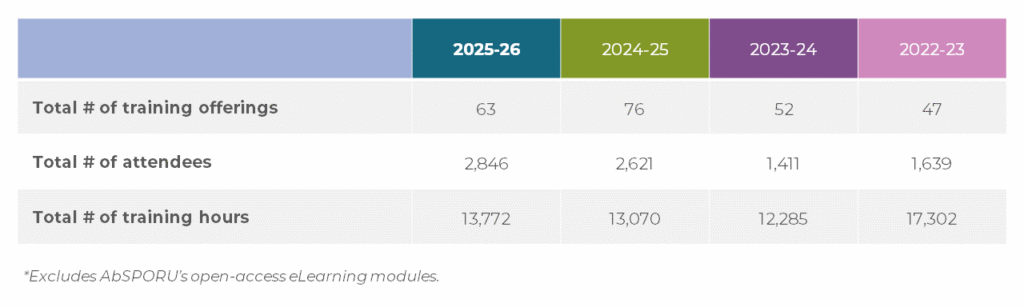
We prioritize continuous improvement of our training and have introduced a refined set of standardized evaluations as well as new demographic tracking mechanisms across our eLearning portfolio. This provides new insights into our learner reach, educational outcomes, and capacity development needs while informing iterative improvements to training offerings to ensure we remain responsive to learners’ emerging needs and considered as the leader in patient-oriented research training in Alberta.

These evaluations have consistently demonstrated strong demand for flexible, applied learning opportunities. To support continuous improvement, the CD Team introduced a refined set of standardized learner evaluations and new demographic tracking mechanisms across its eLearning portfolio, providing new insights into learner reach, educational outcomes, and future capacity development needs.